The Real Cost of Buying a Condo in Thailand: Fees, Taxes & Hidden Extras
Transfer fees, specific business tax, sinking funds and common-area fees explained, with a worked example so you can budget with no surprises.
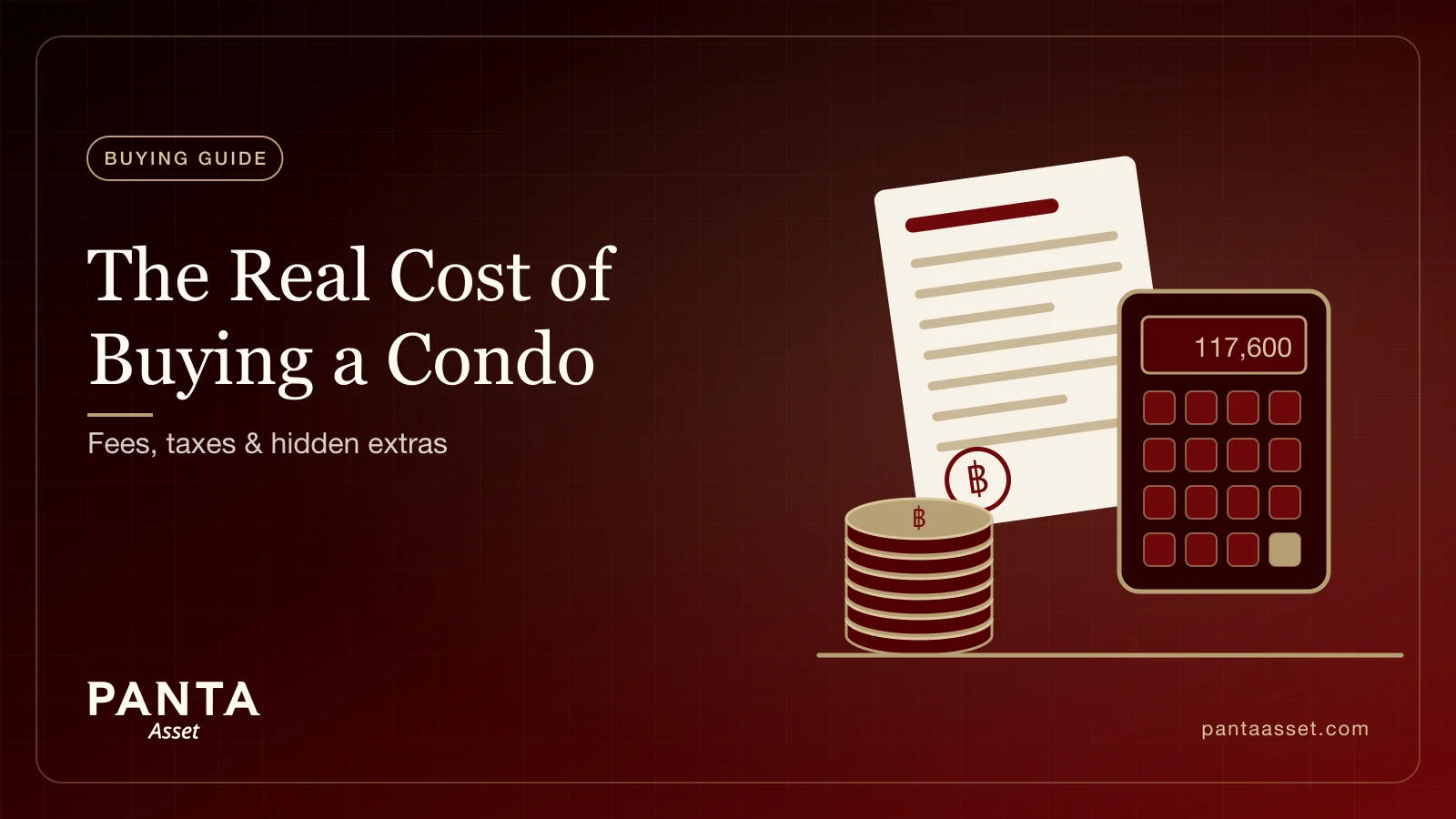
The price on the brochure is never the full story. When you buy a condo in Thailand, you’ll pay government fees at the Land Office, one-off charges to the building and ongoing running costs. None of it is complicated, but it’s much nicer to know it before transfer day.
Costs paid at the Land Office on transfer day
The Land Office calculates most fees from the government appraised value of the unit, which is often lower than the market price.
| Cost | Typical rate | Who usually pays |
|---|---|---|
| Transfer fee | 2% of appraised value | Negotiable; often split 50/50 |
| Specific Business Tax (SBT) | 3.3% of the higher of appraised or sale price | Seller (if held under 5 years) |
| Stamp duty | 0.5% of the higher of appraised or sale price | Seller (only if SBT doesn’t apply) |
| Withholding tax | Individual: progressive; company: 1% | Seller |
| Mortgage registration | 1% of loan amount | Buyer (if financing in Thailand) |
A few notes:
- Everything is negotiable. For new projects, developers often advertise promotions such as “free transfer fee”. For resale units, buyer and seller agree the split in the contract.
- SBT and stamp duty are alternatives. If the seller has owned the unit for less than five years, SBT applies. If not, stamp duty applies instead.
- Temporary fee cuts: the government has sometimes reduced transfer and mortgage fees for lower-priced homes. Eligibility depends on the conditions in force at the time, so we’ll confirm what applies to your transfer date.
One-off charges from the building
- Sinking fund: a one-time contribution to the building’s long-term repair reserve, charged per square metre. It’s usually paid by the first buyer of a new unit. On resale it normally stays with the unit.
- Utility meter deposits: for electricity and water, usually a few thousand baht.
- Legal fees: an independent lawyer to review your contract and run due diligence. We always recommend one.
Ongoing running costs
- Common area maintenance fee (CAM): charged per square metre per month and often billed 12 months in advance. It covers security, cleaning, pools, gyms and so on. Luxury buildings charge more.
- Land and Buildings Tax: an annual local tax. For a typical residential condo the amount is small, but it depends on use and value.
- Insurance, furnishing and upkeep: often forgotten in first-time budgets.
- Income tax on rent: if you rent the unit out, rental income earned in Thailand is taxable in Thailand.
A worked example (illustrative only)
Say you buy a new 35 m² condo for THB 5,000,000 in Bangkok. The appraised value is THB 4,500,000, and you agree to split the transfer fee with the developer.
| Item | Calculation | Your cost (THB) |
|---|---|---|
| Transfer fee (your 50%) | 4,500,000 × 2% ÷ 2 | 45,000 |
| Sinking fund | 35 m² × 700 | 24,500 |
| CAM fee, first year | 35 m² × 55 × 12 | 23,100 |
| Meter deposits | Approx. | 5,000 |
| Lawyer review | Approx. | 20,000 |
| Total on top of price | ≈ 117,600 |
That’s roughly 2.4% on top of the purchase price. It’s a useful rule of thumb, but rates for the sinking fund and CAM vary a lot between buildings, so always ask for the exact figures.
Our promise: a full breakdown upfront
Before you put down a deposit, we give you a written breakdown of every fee and who pays it. No surprises at the Land Office and no awkward conversations later. That’s how we work.
Figures are for illustration only and are not tax advice. Rates and exemptions can change. Confirm current amounts with the Land Office, your lawyer or a tax adviser.