Can Foreigners Buy a Condo in Thailand? The 2026 Ownership Guide
Freehold condos, the 49% foreign quota, the FET form and why land is off-limits: what foreign buyers need to know before buying in Bangkok or Chonburi.
It’s the first question almost every overseas client asks us: “Can I actually own property here?” The short answer is yes. A condominium is the simplest, most secure way for a foreigner to own real estate in Thailand, and you can hold it in your own name, freehold, with a title deed.
The longer answer has a few rules you need to follow. Here’s what they are and how to stay on the right side of them.
Condos: freehold ownership in your own name
Under Thailand’s Condominium Act, foreign nationals can own condo units outright. Your name goes on the unit’s title deed, and you can sell it, rent it out, or pass it on, just like a Thai owner.
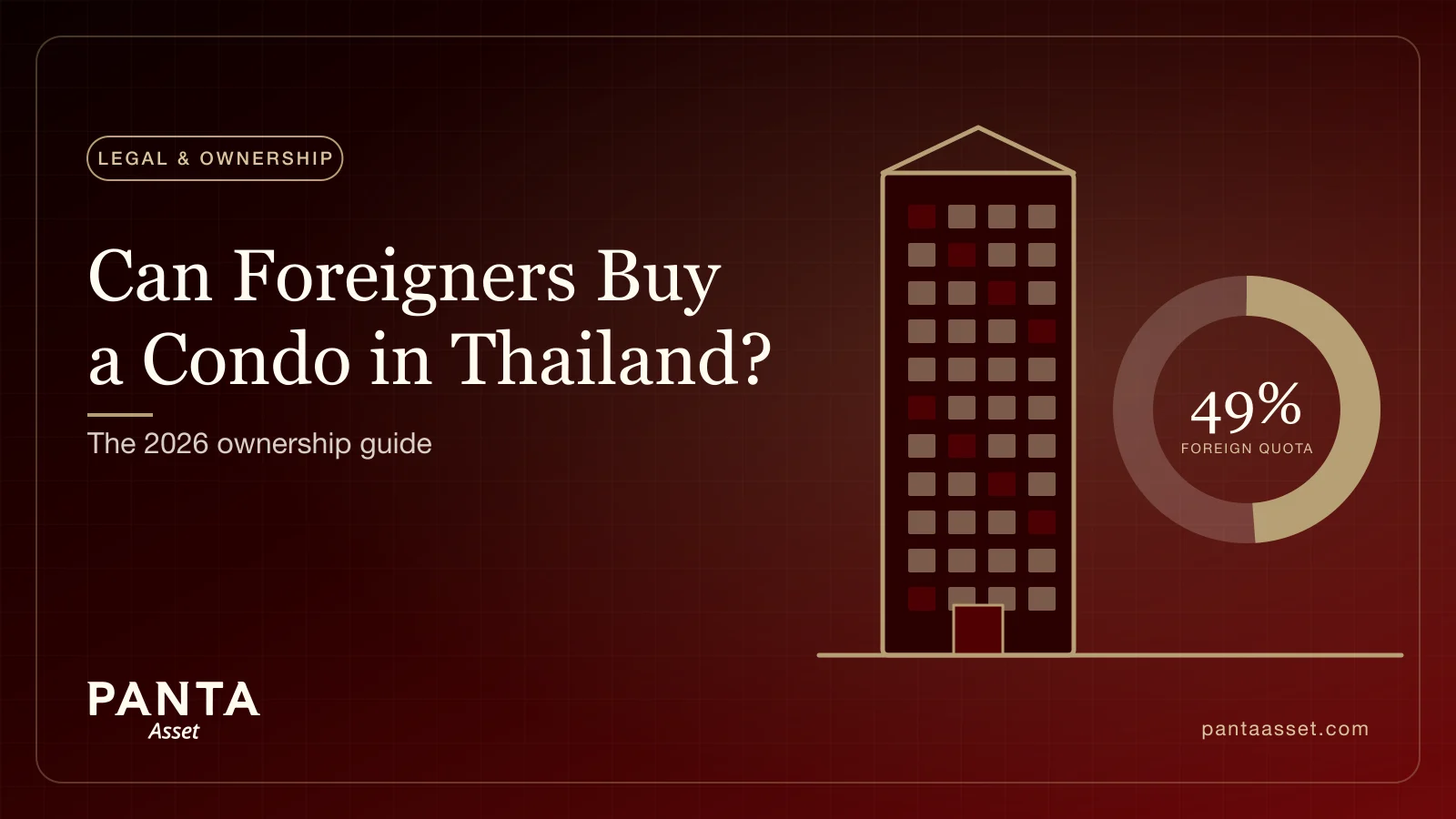
There is one important limit: foreigners can own no more than 49% of the total saleable floor area of a building. The other 51% must be owned by Thai nationals or Thai entities. This is called the foreign quota.
Why the foreign quota matters to you
- New projects usually set aside a block of units for foreign buyers. Popular buildings in Sukhumvit, Sathorn or Pattaya’s beachfront can sell out their quota early.
- Resale units are trickier. If the unit you love is currently registered under the Thai quota, it can only be transferred to you if foreign quota space remains in that building.
- Before you pay a deposit, ask the developer or the building’s juristic person office to confirm in writing that foreign quota is available for your unit. We do this as standard for every client.
Bringing your money in: the FET form
To register a condo in a foreigner’s name, the Land Office needs proof that the purchase money came from overseas, in foreign currency.
- Transfer the funds from an overseas account to a Thai bank account (yours, or the developer’s/seller’s).
- Make sure the transfer reference states the purpose, e.g. “Purchase of condominium unit [unit no.] at [project name]”.
- The receiving Thai bank converts the currency and issues a Foreign Exchange Transaction Form (FET), or a bank credit advice for smaller amounts.
- You present this document at the Land Office on transfer day.
Keep this paperwork safe. It also makes it easier to take your money back out of Thailand when you eventually sell.
Tip: Don’t convert the money to baht before sending it. The conversion needs to happen in Thailand for the paperwork to be issued correctly.
What about land and houses?
Foreigners cannot own land in Thailand in their own name. You’ll see a few common alternatives:
- Leasehold: you can register a lease of up to 30 years at the Land Office. Renewal clauses are often written into contracts, but renewal is not guaranteed to be enforceable, so treat a lease as 30 years of use, not ownership.
- Owning the building, leasing the land: a foreigner can own a house as a structure while leasing the land under it.
- Thai company structures: setting up a company with Thai “nominee” shareholders just to hold land is illegal, and the authorities do audit these. We won’t recommend it, and neither should anyone else.
For most buyers who want a home or an investment with clear legal title, a condo is still the cleanest route.
Your pre-purchase checklist
- ✅ Foreign quota confirmed in writing for your specific unit
- ✅ Funds sent from abroad in foreign currency, with the purpose stated
- ✅ Title deed checked: the developer or seller is the registered owner, with no undisclosed mortgage
- ✅ For resale units, a debt-free letter from the juristic person (no outstanding common fees)
- ✅ Sale and purchase agreement reviewed by an independent lawyer
- ✅ Transfer fees and taxes agreed in writing (see our guide to buying costs)
Does owning a condo get me a visa?
No. Owning property in Thailand doesn’t come with residency or a visa. If you plan to live here, look at options such as the Long-Term Resident (LTR) visa, retirement visas or the Thailand Privilege programme separately.
How Panta Asset helps
We check the foreign quota, coordinate with your bank on the FET, introduce you to trusted independent lawyers, and go with you to the Land Office on transfer day. There’s no pressure and no hard sell, just clear answers so you can buy with confidence.
This article is general information, not legal advice. Rules and procedures can change, so always confirm current requirements with a qualified Thai lawyer or the Land Office before you commit.